

PATADaily.id - Cikarang - Journalist: Gabriel Bobby
The era of industrial estates in Indonesia effectively began in the early 1970s with the Pulogadung Industrial Estate, which served as a hub for both domestic (PMDN) and foreign (PMA) industrial investments.
Driven by sustainable development and stable economic growth—which at one point reached 8%—industrial estates became essential centers for labor absorption. Consequently, estates began to emerge across various regions, particularly along the northern coast of Java, followed by expansion into areas outside Java.
Jababeka Industrial Estate currently stands as the largest of its kind, spanning approximately 5,000 hectares and hosting over 2,000 manufacturing companies—including UT, Unilever, Komatsu, Samsung, and Dexa, alongside medium-sized enterprises—and is equipped with a dry port facility. Furthermore, Jababeka has played a role in developing industrial estates in Kendal, Morotai (North Maluku), and Tanjung Lesung.
These estates have evolved into comprehensive industrial ecosystems featuring a wide range of infrastructure, such as electricity supply, clean water and wastewater treatment, security, and transportation systems.
They play a vital role in contributing to both the national GDP and regional revenue (PAD), employing approximately one million workers directly in the manufacturing sector while creating extensive business opportunities in the informal, property, and service sectors. The presence of numerous foreign companies in the Jababeka and Kendal estates demonstrates the quality of their estate management, which is both reliable and internationally recognized.
In tandem with this rapid development—and alongside neighboring estates such as MM2100, EJIP, and Karawang—Jababeka has complemented its industrial facilities with healthcare services and educational institutions at various levels. President University holds the distinction of being the first university located within an industrial estate to offer English-medium instruction and host a diverse student body from Asia and Africa. It has expanded its academic offerings to include doctoral programs and a Faculty of Medicine—established in 2023—complemented by a hospital that is set to begin trial operations in October 2026.
Vincent Jaya Saputra, an entrepreneur with business operations in the Jababeka area, warmly welcomed the arrival of the President University Hospital. "We at Kencana Group are proud to see the President University Hospital begin operations. We also support the hospital's ecosystem by supplying Telson syringes, solar panels—produced in partnership with Cikarang Listrindo—and electric batteries through a joint venture with SAIC Group and CATL, all based within or near the Jababeka area," he said.
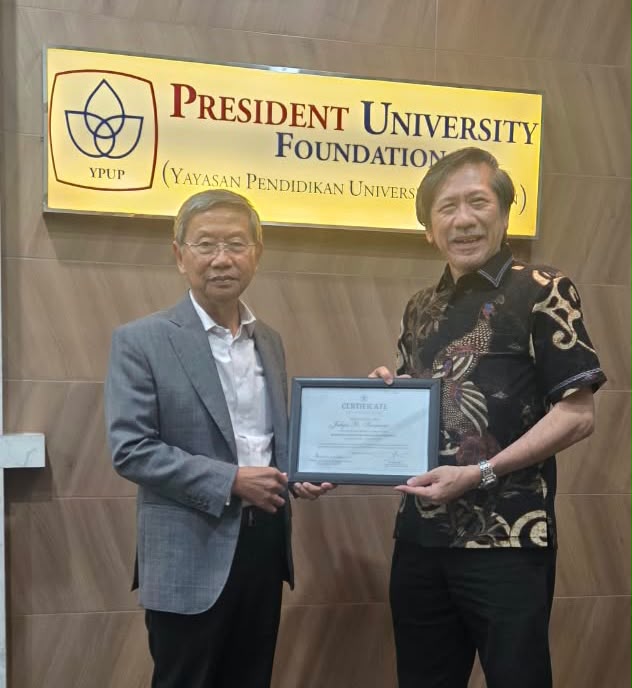
"An industrial estate is more than just a real estate venture; it must build an ecosystem that provides comprehensive services, including education and healthcare. This is the path the Jababeka Group is taking—a path of necessary, continuous growth—because building a business ecosystem means ensuring long-term sustainability that safeguards shared interests. This same priority is shared by other reputable industrial estate developers," observed Jahja B Soenarjo, Chairman of the CEO Business Forum Indonesia, who also contributes to President University.
This integrated estate ecosystem model is a hallmark of self-sufficient industrial cities, such as those commonly found in Japan, South Korea, and China.



.png)