

PATADaily.id - Cikarang - Journalist: Gabriel Bobby
Jababeka has long been recognized as a pioneer in transforming Cikarang from a conventional industrial estate into an integrated modern city combining industry, education, healthcare, and tourism.
“Looking ahead, we envision Cikarang becoming a destination for industrial, educational, and medical tourism, as well as an international meeting place for scientists, business owners, inventors, academics, and investors from around the world,” said Setyono Djuandi Darmono, President Director of PT Jababeka Tbk, in an interview with PATADaily.id on Monday, October 12, 2026.
Darmono explained that Cikarang could become a place where international visitors meet, exchange knowledge, develop technology, conduct research, establish business partnerships, and enjoy the facilities of a modern city.
With thousands of industrial companies, President University, and the President University Research and Teaching Hospital, Cikarang has tremendous potential to develop into a unique destination centered on industry, knowledge, technology, innovation, and healthcare.
“We want people to come to Cikarang not only to work or conduct business, but also to learn, receive medical treatment, discover opportunities, create innovations, and build international friendships,” he added.
“This is our vision: Building Industries, Building Cities, Building Civilizations. Guided by our philosophy, Think Big, Start Small, Move Fast, we will bring this vision to life progressively through collaboration with various partners.”
According to Darmono, the concept that should be continuously promoted is:
“Cikarang — A Global Destination for Industry, Knowledge, Health and Innovation.”
This could become Cikarang’s new international identity, distinguishing it from conventional industrial cities.
Darmono made these remarks in response to a PATADaily.id article https://patadaily.id/pages/industrial-estates-as-economic-growth-ecosystems entitled “Industrial Estates as Ecosystems of Economic Growth.”
The Evolution of Industrial Estates in Indonesia
The era of industrial estates in Indonesia began in the early 1970s with the establishment of the Pulogadung Industrial Estate, which became a major center for domestic investment (PMDN) and foreign direct investment (PMA).
As Indonesia pursued sustainable development and enjoyed relatively stable economic growth, at times reaching 8%, industrial estates became increasingly important as centers of employment generation.
New industrial estates subsequently emerged across Indonesia, particularly along the northern corridor of Java, before expanding into regions beyond Java.
Today, the Jababeka Industrial Estate is one of Indonesia’s largest industrial developments, covering approximately 5,000 hectares and accommodating more than 2,000 manufacturing companies.
These include major corporations such as United Tractors, Unilever, Komatsu, Samsung, Dexa, and numerous medium-sized enterprises. The estate is also supported by a dry port and integrated logistics facilities.
Beyond Cikarang, Jababeka has participated in developing industrial and economic zones in Kendal, Morotai in North Maluku, and Tanjung Lesung.
Over the years, these developments have evolved into comprehensive industrial ecosystems supported by essential infrastructure, including electricity generation and distribution, clean water supply, wastewater treatment, security, transportation, and logistics.
Their contribution to Indonesia’s gross domestic product (GDP) and regional economic development has been significant.
The broader industrial ecosystem supports approximately one million direct manufacturing jobs while creating extensive opportunities in informal businesses, property development, and service industries.
The presence of numerous international corporations in Jababeka and Kendal also demonstrates the quality of their estate management and the growing international recognition of Indonesia’s industrial estate capabilities.
Integrating Education and Healthcare with Industrial Development
As industrial development in Cikarang accelerated, alongside neighboring industrial estates such as MM2100, EJIP, and developments extending toward Karawang, Jababeka recognized the importance of complementing industrial growth with education and healthcare facilities.
President University became a pioneering university located within an industrial estate, offering English-medium education and attracting international students from countries across Asia and Africa.
The university has continued to expand its academic offerings, including doctoral programs and a Faculty of Medicine established in 2023.
Remarkably, within approximately three years of establishing its Faculty of Medicine, President University has also developed its own Research and Teaching Hospital, which commenced its initial trial operations in October 2026.
The hospital represents a significant step toward integrating industrial development, higher education, medical services, and scientific research within a single urban ecosystem.
Support from the Business Community
Vincent Jaya Saputra, a businessman whose operations are also located within the Jababeka industrial ecosystem, welcomed the opening of President University Hospital.
“We at Kencana Group are proud to see the commencement of operations at President University Hospital and are pleased to support the development of its broader ecosystem through our Telson syringe products, solar panel initiatives in cooperation with Cikarang Listrikindo, and electric battery joint ventures involving SAIC Group and CATL, located in and around the Jababeka area,” he said.
His comments reflect the growing opportunities for collaboration between industrial companies, healthcare institutions, research organizations, and technology providers.
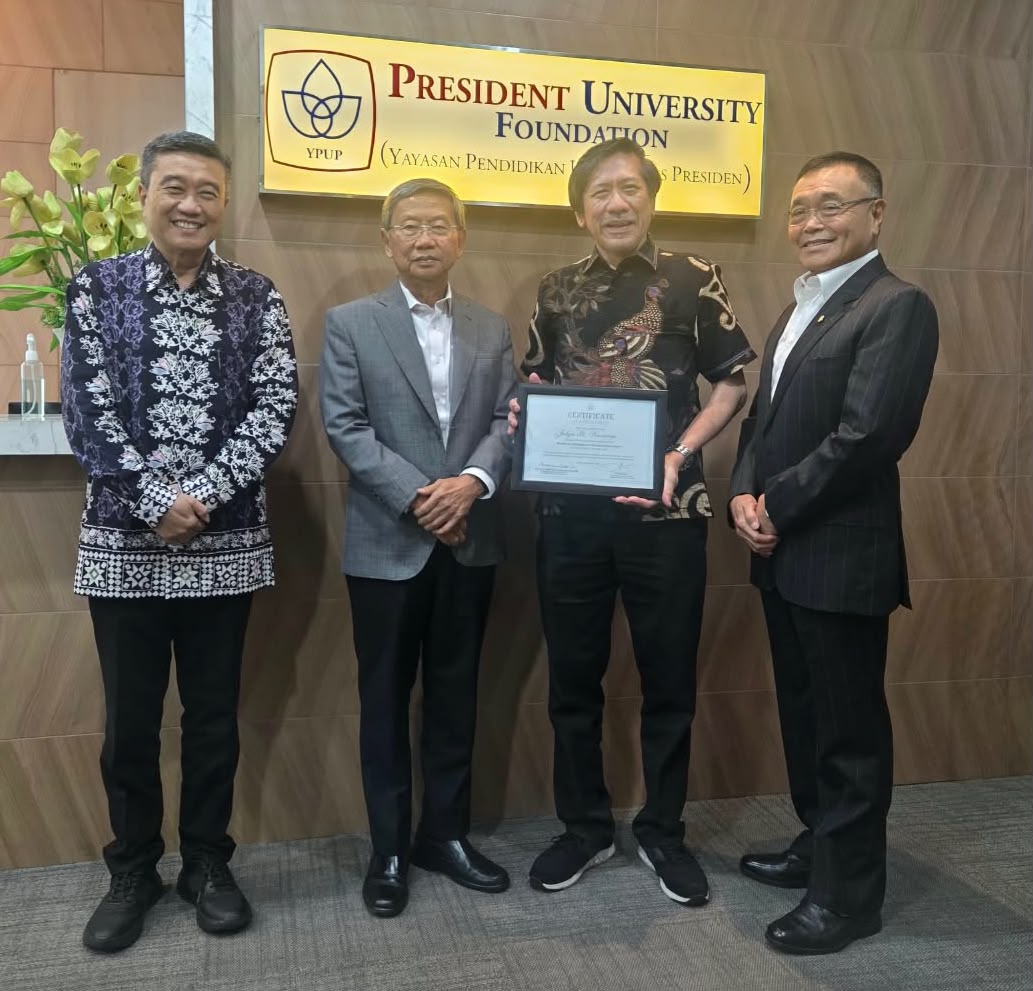
Jahja B. Soenarjo, Chairman of the CEO Business Forum Indonesia, who has also contributed to the development of President University, emphasized the broader significance of this integrated approach.
“An industrial estate is much more than a property business. It must develop a complete ecosystem that provides essential services, including education and healthcare.
“This is precisely what the Jababeka Group is doing. Such ecosystems must continue to evolve because building a business ecosystem means ensuring long-term sustainability while protecting the shared interests of all stakeholders.
“The same principle should also guide other responsible and reputable industrial estate developers,” he told PATADaily.id over the weekend.
Toward a New Model of Integrated Industrial Cities
This model of integrated industrial development has become a defining characteristic of successful self-sustaining industrial cities in countries such as Japan, South Korea, and China.
In these countries, industrial development has increasingly been connected with residential communities, educational institutions, healthcare services, research centers, commercial activities, and modern urban infrastructure.
Cikarang is now moving in a similar direction, building upon its existing industrial strengths while developing new capabilities in education, medical services, scientific research, technology, and international collaboration.
The long-term vision is to transform Cikarang from a manufacturing center into a globally connected city where industries generate economic opportunities, universities develop human talent, hospitals improve quality of life, and international partnerships accelerate innovation.
The ultimate ambition is not merely to attract more factories, but to create a city where people from different countries, cultures, and professional backgrounds can work together, exchange ideas, generate prosperity, and contribute to human progress.
Cikarang — A Global Destination for Industry, Knowledge, Health and Innovation.
Building Industries, Building Cities, Building Civilizations






.png)